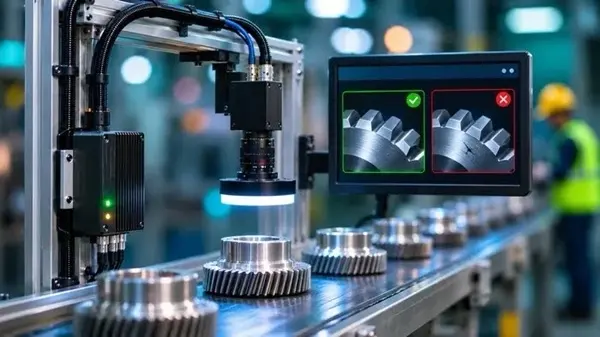
Five years ago, AI visual inspection was a project only the largest OEMs could afford: special cameras, sealed lighting boxes, months of integration. Today the same capability runs on standard industrial cameras and a computer the size of a lunchbox, learns from a plant's own parts and is live in weeks — at a fraction of the cost.1 Opsio, the Bengaluru-based industrial AI company, today opened its AI Visual Inspection to India's mid-sized manufacturers: the Tier-2 and Tier-3 suppliers that Make in India is built on.
India has already won the first battle: it makes the parts the world wants. Auto component exports reached USD 24 billion last year,4 smartphones became the country's single largest export and one in five generic medicines on earth is Indian.2 The next battle is proof — showing a buyer in Detroit or Stuttgart that every part has been inspected, not a sample. Opsio's systems catch more than 97 percent of defects, against the 80 to 85 percent of manual inspection, at 2,000 to 5,000 parts an hour.1
Why the price fell
Three things. AI models that have already learned from millions of images now need only a few hundred to a thousand photos of a plant's own parts to learn what good and bad look like. The computing happens on a small industrial computer next to the line, so there is no dependence on internet connectivity and no images leave the factory — important across the industrial belts of Maharashtra, Tamil Nadu and Gujarat. And the difficult work — keeping the system accurate over time and connecting it to the line's existing controls and reject gates — is now built into the platform instead of being engineered from scratch each time.1
Make in India's next test is quality at scale
Twelve years on, Make in India has delivered. Manufacturing makes up 16 to 17 percent of GDP, employs more than 27 million people and grew 10.7 percent in FY2025-26.2,3 The auto component industry hit a record INR 7.6 lakh crore (USD 85.9 billion), up 12.7 percent in a year.4 Electronics production rose 15.8 percent to INR 13.11 lakh crore.2
The next phase will be decided on the inspection station. The US and Germany buy more than a third of India's component exports5 and set defect limits measured in parts per million; pharma exporters answer to WHO, Indian and US regulators. Industry benchmarks put the cost of poor quality at 5 to 35 percent of sales,6 and rejection rates at Indian SMEs between 3 and 15 percent.7 Manual inspection, catching 80 to 85 percent of defects,1 is where much of that cost sits.
“Make in India has done the hard part: the capacity is built, the orders are in and the export markets are open. For a Tier-2 supplier in Pune or Chennai, the question is no longer whether they can make the part, but whether they can show their customer in Germany or Detroit that every part has been checked to the same standard,” said Praveena Shenoy, Country Manager, Opsio. “Until recently, inspection at this level was something you saw at the OEM's plant, not your own. Today we photograph a plant's own good and bad parts and have a system inspecting at over 97 percent accuracy within weeks, on a box that never sends an image out of the factory. The inspector doesn't disappear; they move from staring at parts to running the system and fixing root causes.”
What Opsio delivers
-
Learns from your parts. Images are collected on the customer's own line, so the system knows its lighting, fixtures and part variants.
-
Runs on the line, data stays on-site. Decisions in under 50 milliseconds on a small industrial computer; no images leave the factory.1
-
Fits the line you have. Connects to existing controls, conveyors and reject gates; no rebuild.
-
Audit-ready. Tamper-proof records and electronic signatures for pharmaceutical lines; weld, surface and assembly checks for automotive suppliers.
-
Pays for itself. Up to 80 percent lower quality-control cost on inspected lines; payback typically within six to twelve months.1
Availability
Opsio's AI Visual Inspection is available now across India. It starts with a two-week assessment of the production line that ends with a clear recommendation, expected accuracy and expected return; the cost is credited against a full deployment. Priority sectors are automotive, pharmaceuticals and medical devices, electronics and metal fabrication, delivered from Bengaluru with teams in Chennai, Gurgaon and Pune. Manufacturers can request an assessment at opsiocloud.com/in/automated-visual-inspection.
References
1. Opsio deployment data from Indian production lines, 2026. Detection accuracy, manual-inspection baseline, throughput, inference time, training-image requirements, cost reduction and payback are Opsio's own figures; supporting data available to media on request.
2. Press Information Bureau, Government of India, "Manufacturing Momentum: Building a Self-Reliant India", 14 August 2026. https://www.pib.gov.in/FactsheetDetails.aspx?Id=150923
3. Ministry of Statistics data reported to the Lok Sabha, via ANI / The Tribune, "Manufacturing GVA grows 10.7% in FY26", 12 August 2026. https://www.tribuneindia.com/news/business/manufacturing-gva-grows-10-7-in-fy26-govt-cites-reforms-to-strengthen-sector/
4. Automotive Component Manufacturers Association of India (ACMA), Industry Performance Review FY2025-26, 7 July 2026, as reported by Autocar Professional. https://www.autocarpro.in/news/acma-indian-auto-component-industry-grows-127-percent-to-inr-76-lakh-crore-in-fy26-133454
5. Autocar Professional, "Auto Component Exports Rise 5%", 7 July 2026 (US 26%, Germany 9% of FY26 component exports). https://www.autocarpro.in/news/auto-component-exports-rise-5-percent-acma-expects-trade-deals-to-drive-next-growth-phase-133469
6. Institute of Industrial and Systems Engineers (IISE) cost-of-poor-quality benchmarks, summarised in "Manufacturing Scrap Rate Benchmarks 2026". https://manufacturingleadgeneration.com/manufacturing-scrap-rate-benchmarks/
7. Leanworx, "Rejection Analysis in Manufacturing", 2026. https://leanworx.ai/rejection-analysis-in-manufacturing/